Delay the answer.
The estimate comes first. Committing preserves the original judgment, so the reveal shows an actual relationship rather than a guess rewritten in hindsight.
A meditation on seeing.
A colour-study instrument, born in the painting studio. Look. Make an assumption. See what changes.
Painting asks us to notice relationships: light and shadow, a warm note against a cool ground, the quiet emotion of a muted colour. A screen can give us a value. It cannot tell us what we thought we saw.
I made Pigment to hold that moment open. Colour theory becomes something to experience: estimate before the answer, compare without the surrounding image, then look again. The aim is to learn to see more deeply.
Sun’s warmth on my skin on a cool fall morning. A moment of realization.
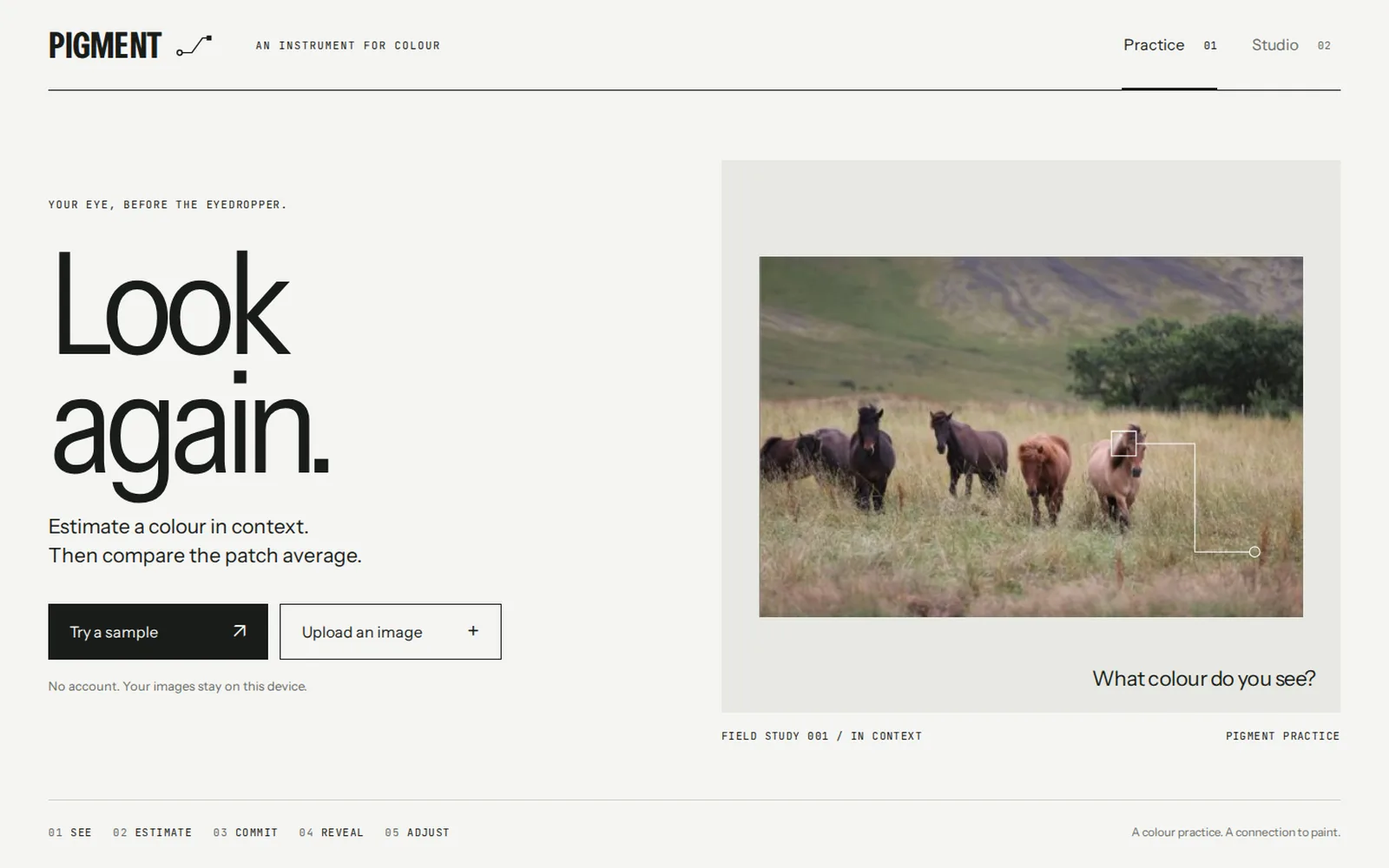
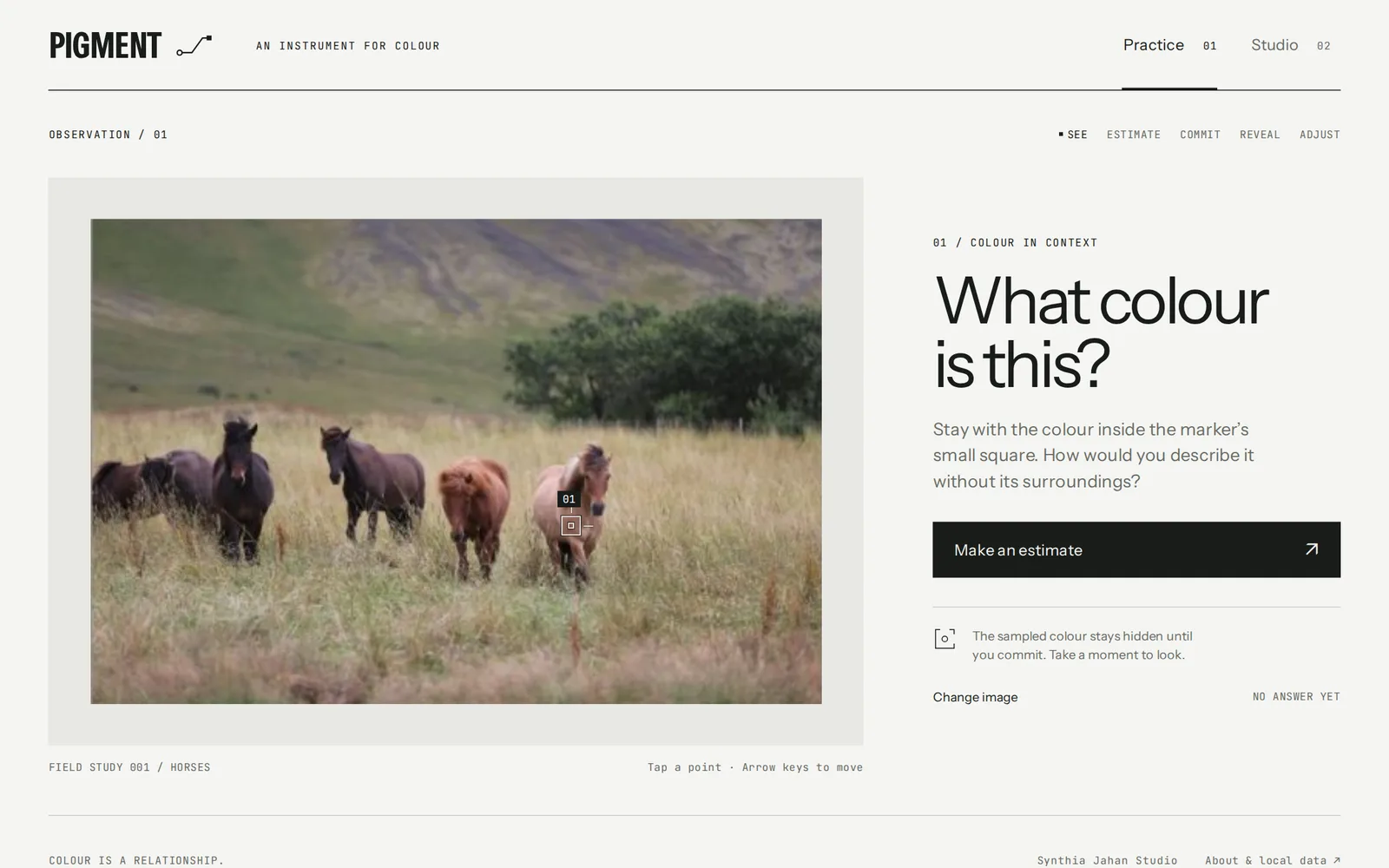
A small working study from Pigment. Choose a point in the image, estimate its colour, then commit to see the sampled patch.
The reference value stays hidden until you commit.
This study uses Pigment’s estimate-first logic and local image sampling. A sampled screen value is a reference for comparison; camera processing, your display and real paint all affect the result.
Still.
A blue can feel still. An orange can feel urgent. Change the colour and notice what it does to you.
Crisp blue sky, familiar suburban flare. A moment of gratitude.
Practice is the full method: choose a point, estimate, commit, reveal, adjust. Studio then compares what you see with the paints you own. No account, and your images stay on your device.
The estimate comes first. Committing preserves the original judgment, so the reveal shows an actual relationship rather than a guess rewritten in hindsight.
Estimate and sampled reference share a neutral ground. Hue, lightness and intensity can be considered separately. One adjustment turns comparison into another act of looking.
Studio compares a reference with the paints you own and a 72-paint catalogue. When nothing is close enough, that is a useful answer. Mixing estimates invite a small physical test.
Product concept, interaction design and visual direction. AI-assisted implementation and testing.
A working browser product: patch sampling, perceptual comparison, owned-paint palette and mixing estimates.
Testing with painters, the quality of physical mixes and whether repeated practice changes how people judge colour.