M
MayaMonday · Offer
“I can give two hours this week to help a sprint team get their agent running on OmegaClaw.”
Utsa is a portable coordination agent for communities.
Being developed to remember offers and needs over time, suggest useful matches privately, and check in on the date each person chooses until both confirm what happened.

A community can hold the skills it needs and still miss the connection. Offers disappear into the scroll. Needs arrive later. Finding the fit depends on someone remembering both.
Utsa is being designed to carry that context across time, so a new need can find an earlier offer, and people can collaborate beyond the circle they already know.
Utsa coordinates. People decide. Explore an illustrative exchange, from the first posts to a shared outcome.
The two posts arrive days apart, and Utsa remembers both.
Grounded in real postsMatch reasons quote what participants actually wrote, and the claim is drafted from both posts.
Choice at every connectionA suggestion never volunteers someone to do the work. Either person can reword the claim or ignore it.
Each person sets the paceBoth say done to the same claim, on check-in dates each person picks. Silence is not a negative rating.
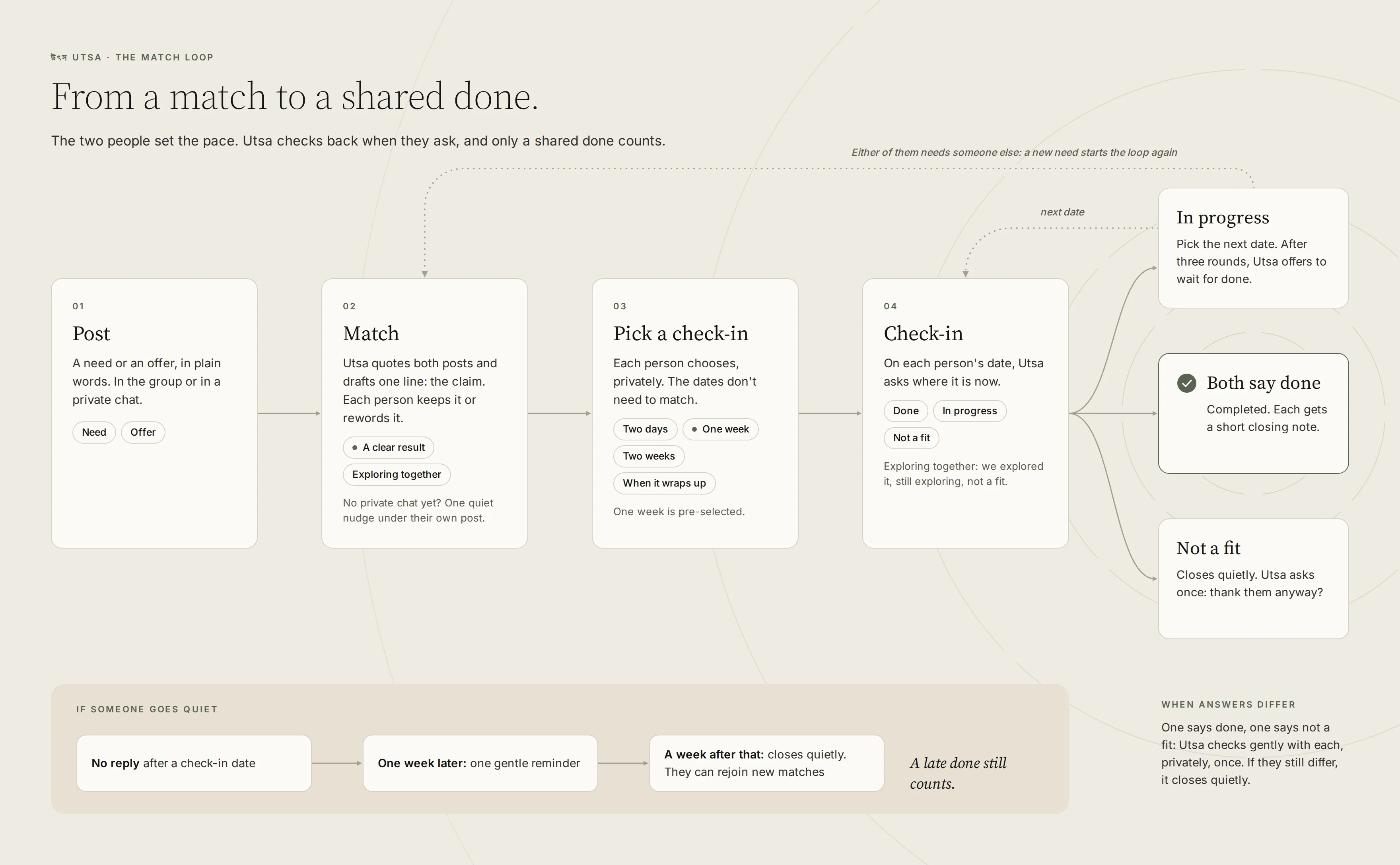
Utsa owns the coordination logic, memory and identity. Each community provides a context; chat and website interfaces provide ways to reach it.
Offers, needs, matching, memory and attestation.
Telegram, the current pilot channel in development
Community websites, as proposed integrations
BGI Commons, the proposed first pilot
SingularityNET and OpenStreetMap, illustrative website concepts
Other communities, future possibilities
Post an offer or need in the community. Receive a relevant suggestion in a private conversation with Utsa.
“Your request may fit an earlier offer. Here’s why, and here’s what it would be.”
Being developed for the BGI Commons pilot. Participants first open a private chat with Utsa.
Utsa embedded inside an existing community surface: review suggested connections and see the status of your exchanges.
Concept only. A future portal could access the same community records as the Telegram pilot.
The same private match experience, adapted for BGI Commons, SingularityNET and OpenStreetMap.
View community website examples
Interactive concepts with fictional posts. Future integrations, not announced partnerships.
Each community would keep its own records and permissions. Any cross-community sharing would require explicit consent.
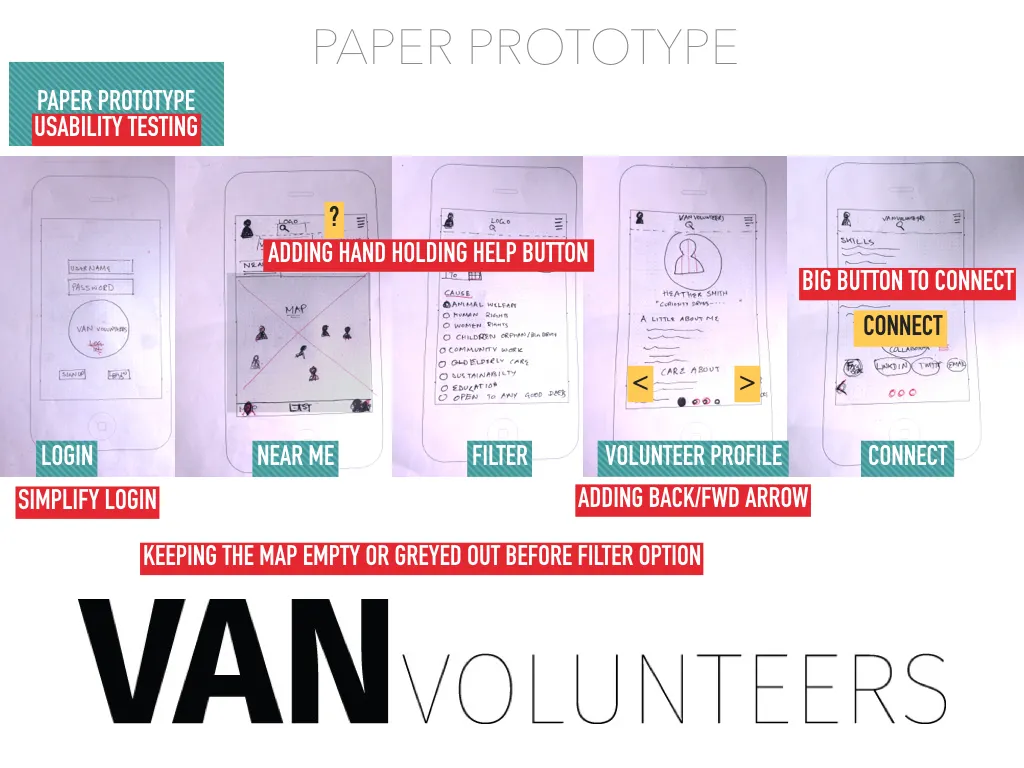
VanVolunteers, Vancouver
How can someone’s willingness to contribute find a place where it is needed?
Synthia Jahan explored that question through VanVolunteers: a concept for discovering volunteers, understanding interests and availability, and making contact.
Utsa was born while Synthia was volunteering with SingularityNET, drawing on ideas she had explored earlier through VanVolunteers. She joined SingularityNET professionally in December 2025.
OfferNet gave that earlier question a coordination framework, and Utsa developed from it into a product for community matching and follow-through.
VanVolunteers concept, paper prototypes, and participation flow.
Born during Synthia’s volunteer work with SingularityNET. Early interface and identity; presented at the BGI Summit in Istanbul.
A proposed MVP and user-study plan for community working groups; it did not ship as a production surface.
A working agent demonstrated through Discord at BGI Sprint I, showing matching across posts made at different times.
Utsa’s own Telegram bot for the proposed BGI Commons pilot, with check-ins on the date each person chooses.
BGI Commons will be Utsa’s first pilot community. The goal is to learn whether remembered offers become useful collaborations.
The next step is to test Utsa in its own Telegram bot, then bring it into the Commons group once private delivery is ready.
What we will measureCompleted exchanges
confirmed by both people.
Accepted connections, claims people reword, and check-ins left open will help explain where the journey works and where it breaks.
Does Utsa find a useful fit?Recognize needs and offers, retain their context, and explain relevant suggestions.
Does private delivery work?Reach participating members reliably, with permission and clear choices.
Does the loop close?Agree a claim at the start, check in on the date each person picks, and record what both people confirm.
Can people stay in control?Reword a claim, correct a record, stop participating, rejoin later, or request removal.
What “attestation” means here: both participants confirm the same completed exchange. It records shared activity; it does not certify quality or create a public rating of a person.
Synthia JahanProduct Owner and designerProduct scope, interaction design, visual identity, agent behaviour, knowledge design, and pilot experience.
OfferNetThe research foundationUtsa translates Ben Goertzel’s OfferNet vision into a practical coordination experience.
OmegaClaw and collaboratorsThe implementation foundationThe current build uses OmegaClaw’s persistent memory. Dhaval Khatri engineered the Discord API integration for the Sprint I prototype.
The early interface study explores a broader vision, including reputation and network views. Those screens are concepts, not features of the current pilot scope.
Utsa is being developed to help communities turn willingness into shared work.